
The European Parliament Must Continue to Act against the Backdrop of the Human Rights Crisis in Azerbaijan
A new European Parliament resolution on Azerbaijan is urgently needed. Repression has deepened, political prisoners now number over 400 people, and EU engagement continues without clear conditions. The Parliament should continue to act to set firm benchmarks, name abuses, and make future cooperation dependent on measurable progress on human rights, democracy and the rule of law.
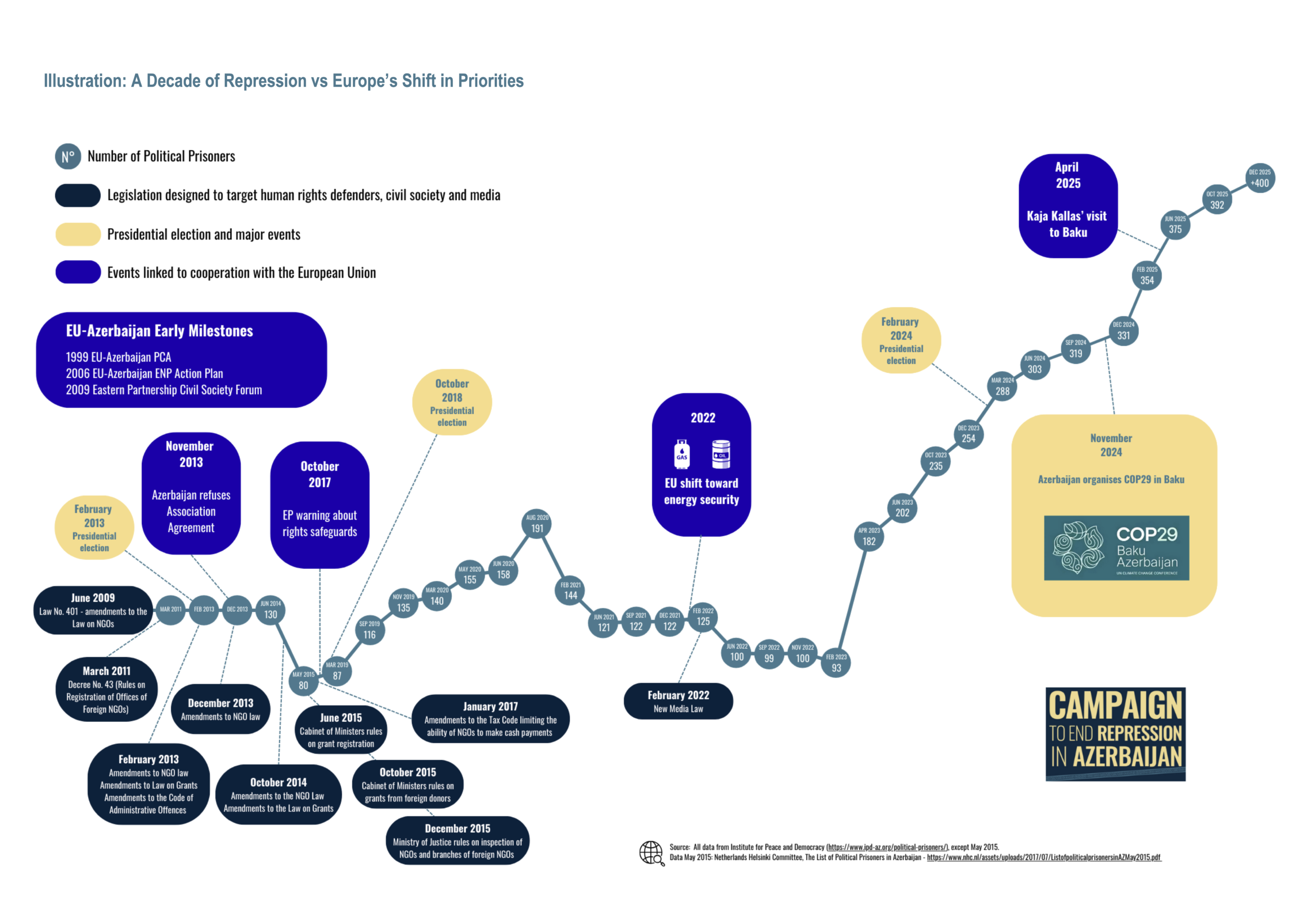
Azerbaijan is experiencing its most severe human rights crackdown since joining the Council of Europe. Independent civil society and media have been dismantled. Human rights defenders, lawyers, journalists, opposition figures and academics face arbitrary detention, abusive prosecutions and long prison sentences. At least 400 people are now imprisoned on politically motivated grounds. At the same time, repression increasingly extends beyond borders through surveillance, intimidation of relatives and criminal cases in absentia.
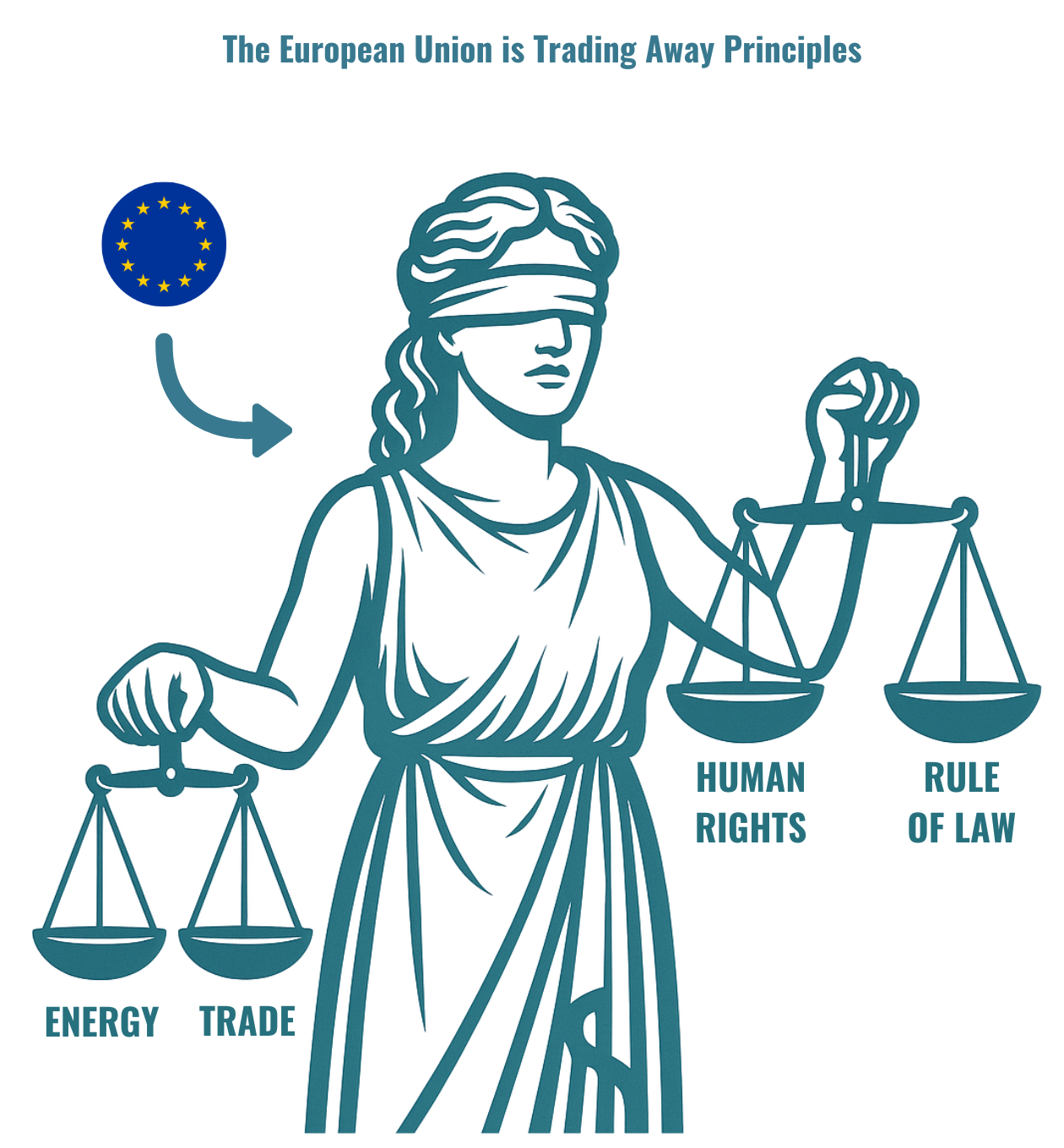
Against this backdrop, the European Union’s response has been fragmented. The European Commission and the European External Action Service have prioritised energy, trade and geopolitical cooperation, particularly since the 2022 energy Memorandum of Understanding. Human rights concerns are raised sporadically, often without visible consequences. This has created a political vacuum that the Azerbaijani authorities have interpreted as tolerance for escalation.
The European Parliament stands out as the institution that has remained most consistent and principled. Its resolutions in 2024 condemned repression, named emblematic cases and called for sanctions and conditionality. Yet these positions have not translated into a coherent EU policy. This gap is precisely why a new, strong European Parliament resolution is now essential.
Such a resolution must serve as a roadmap that aligns the Commission, the EEAS and Member States around clear benchmarks and consequences. At this week’s plenary, the Parliament should use a resolution to fix these benchmarks publicly and unambiguously, so that engagement with Baku is no longer detached from human rights realities:
- First, a resolution should set out clear and measurable benchmarks for EU engagement. These must include the immediate and unconditional release and full rehabilitation of those detained on politically motivated grounds; tangible reforms of NGO and media legislation in line with European standards; and genuine cooperation with Council of Europe and UN mechanisms, including implementation of the Mammadli group of European Court of Human Rights judgments. Without such benchmarks, political dialogue remains empty.
- Second, the Parliament should continue to name individual cases when they illustrate broader patterns of repression. It is a way to make systemic abuse visible and to protect individuals whose cases symbolise how criminal and administrative law are misused to silence dissent.
- Third, the resolution should explicitly condemn the weaponisation of criminal, administrative and tax law against critics. This practice sits at the heart of Azerbaijan’s system of repression. Calling it out clearly matters, because it shifts the narrative from isolated violations to deliberate policy.
- Fourth, the Parliament should call for legislative and policy reforms anchored in existing European standards. The Venice Commission and other Council of Europe bodies have already issued detailed recommendations on NGO laws, media regulation, judicial independence and fair trial guarantees. A resolution can reaffirm that these are not optional references but minimum expectations.
- Finally, and most importantly, the resolution should insist that parliamentary cooperation and inter-parliamentary diplomacy are conditioned on measurable progress. This includes cooperation bodies, delegations and dialogue formats. Engagement without conditions signals acceptance. Conditionality restores credibility.
Placed within the broader EU context, such a resolution would reinforce other necessary steps. It would support making progress on a new EU-Azerbaijan agreement explicitly conditional on human rights benchmarks. It would strengthen the case for using the EU Global Human Rights Sanctions Regime against officials responsible for serious violations. And it would underline that energy cooperation, connectivity and climate policy cannot be insulated from a deepening human rights crisis.
At a moment when EU leverage over Azerbaijan is real, but underused, the European Parliament has a responsibility to lead. Adopting a strong resolution is the clearest way to reassert that human rights, democracy and the rule of law are not negotiable add-ons, but core elements of the EU’s external action.
Join our event discussing
How Europe Needs to Act on
Azerbaijan’s Human Rights Crisis
📆 Wednesday 21 January 2026, 15.00-16.00 CET
📍 Online: register now
The European Parliament is set to debate a potential resolution addressing the human rights crisis in Azerbaijan on Wednesday 17 December 2025.
 AZ
AZ  EN
EN