
EU-Azerbaijan: Trading Away Principles
Our new report examines how the European Union deprioritised human rights in its relationship with Azerbaijan at the very moment the country is undergoing its most intense period of repression since independence.
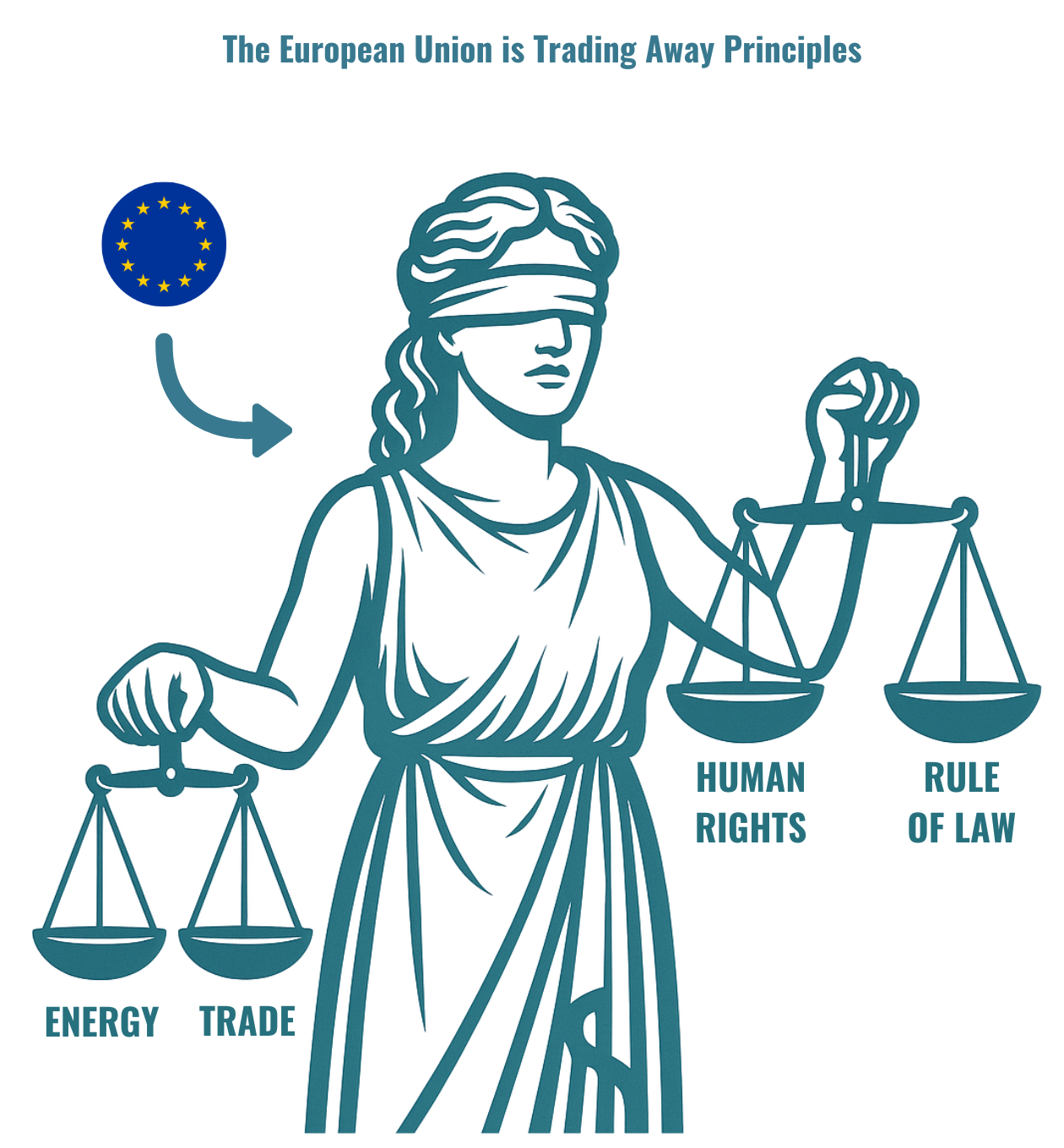
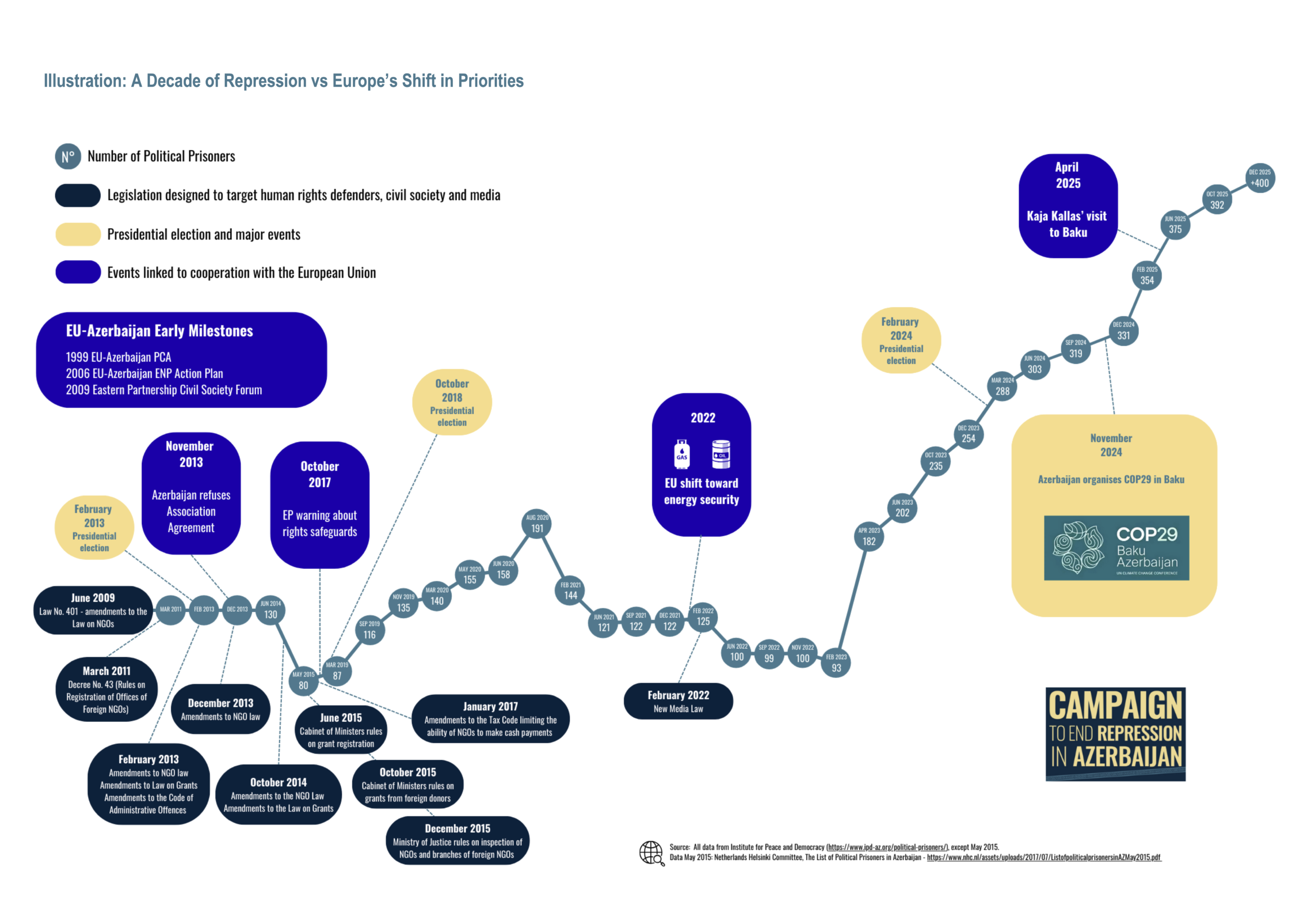
As we document and analyse in our new report, the EU shifted from a values-based partnership to a transactional approach centred on energy, trade and connectivity. This shift has coincided with a dramatic closing of civic space inside Azerbaijan and with the expansion of repression beyond its borders.
Key Findings from the Report:
- The European Union shifted from a values-based relationship with Azerbaijan to a transactional one, where energy and geopolitical interests take precedence over human rights.
- At the same time, Azerbaijan consolidated an entrenched authoritarian system, with record numbers of political prisoners and the near-eradication of independent media.
- Despite being Azerbaijan’s main export market and largest investor, the EU is not using its leverage; political silence at senior level is interpreted in Baku as a green light to deepen repression.
- EU institutions speak in dissonant voices: while the European Parliament calls for conditionality, sanctions and suspension of the 2022 energy memorandum, the Commission and EEAS continue engagement largely insulated from the human rights crisis.
- Azerbaijan’s repression now extends beyond its borders through transnational repression targeting exiled journalists, activists and human rights defenders, while EU responses and host-state protections remain fragmented and insufficient.
Key Recommendations Made in the Report:
- Placing human rights, democracy and the rule of law at the centre of any renewed EU-Azerbaijan agreement and of the implementation of the 2022 energy Memorandum of Understanding, with clear, public benchmarks including the release and rehabilitation of political prisoners.
- Making progress on new agreements and high-level cooperation explicitly conditional on measurable reforms, and being prepared to suspend negotiations or halt new deals if repression escalates.
- Scaling up political, financial and practical support to independent Azerbaijani civil society and media, inside the country and in exile, and strengthening protection against transnational repression in EU member states.
- Ensuring that EU member states align their bilateral energy, trade and security engagement with common human rights benchmarks so that no national deal undercuts EU conditionality or signals that human rights can be traded away.
Join our event discussing
How Europe Needs to Act on
Azerbaijan’s Human Rights Crisis
📆 Wednesday 21 January 2026, 15.00-16.00 CET
📍 Online: register now
 EN
EN  AZ
AZ