
The European Parliament Adopts New Resolution on Azerbaijan, Reinforcing Calls for Conditionality and Accountability
On 18 December 2025, the European Parliament adopted a new resolution condemning the arbitrary arrest and imprisonment of Azerbaijani scholars Bəhruz Səmədov and İqbal Əbilov. Beyond these individual cases, the resolution sends a clear political signal: repression in Azerbaijan has reached a level that requires a firmer, structured and sustained EU response.
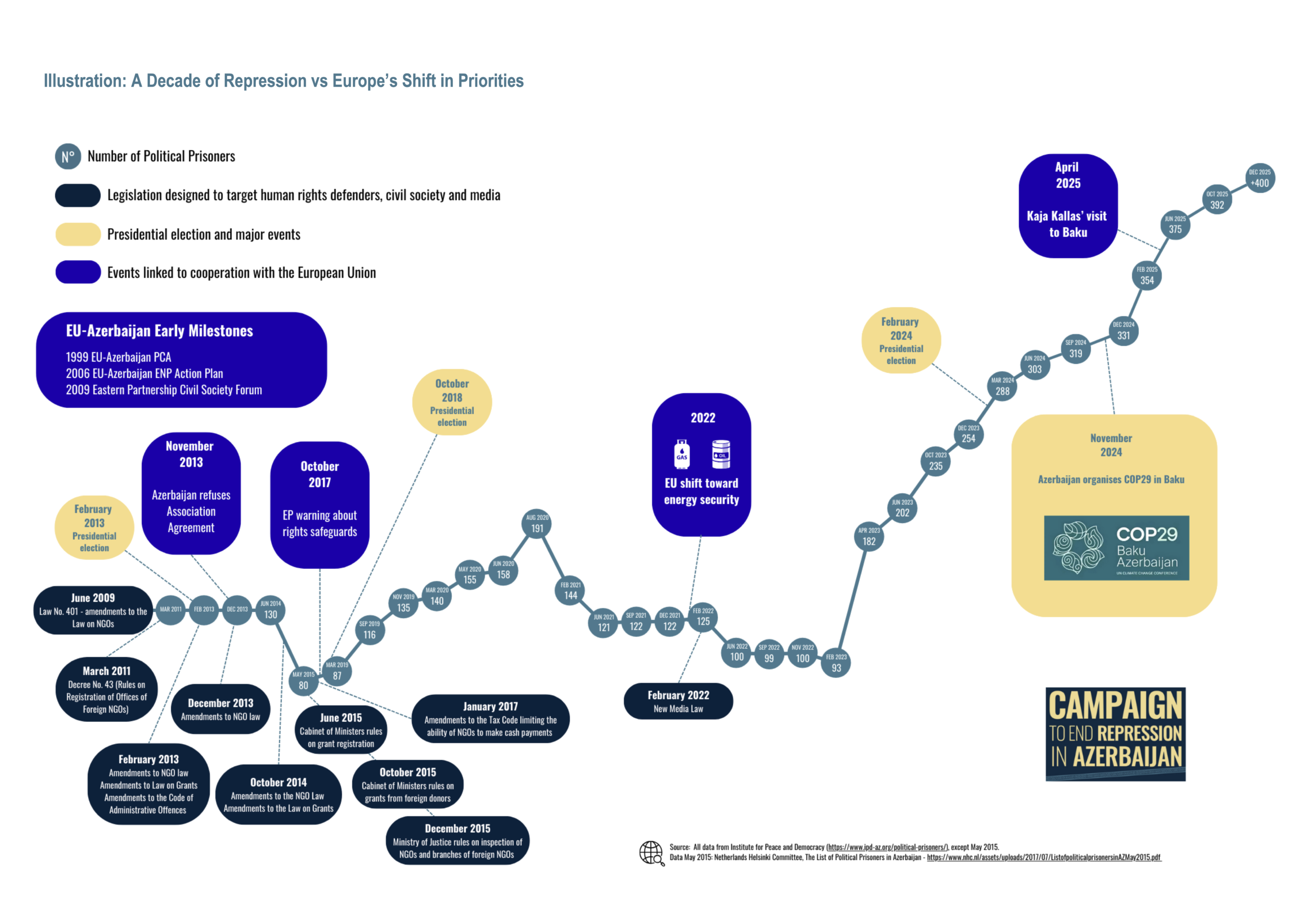
The Parliament explicitly recognises that the number of political prisoners has risen to nearly 400. This reflects the central finding of our report, which documents how Azerbaijani authorities have built a system of repression designed to eliminate independent civil society, media and academic freedom. By situating these cases within a wider pattern of politically motivated prosecutions, the resolution confirms that the problem is systemic, not exceptional.
Human rights lawyer Samed Rahimli, member of the Steering Committee of the Campaign to End Repression in Azerbaijan, welcomed the adoption of the resolution, stressing its political significance at a moment of escalation:
“The resolution is an important step in this crucial moment of escalation of the crackdown in Azerbaijan. The European Parliament remains one of the few European institutions for defending the rights of persecuted critical civic space in Azerbaijan. Today’s resolution demonstrates that the Azerbaijani question is not off the agenda of international fora. The Azerbaijani Government does not only pursue a systematic crackdown against opposition, civil society and media. This Government also wages war against a rule-based international order. EU must act and prevent it.”
Crucially, the resolution names emblematic individual cases. It condemns the convictions of Səmədov and Əbilov, recalls earlier cases such as Qubad İbadoğlu and Fazil Qasımov, and denounces the arrest of opposition leader Ali Karimli. This directly reflects our recommendation that the European Parliament continue to name individual cases when they illustrate broader patterns of repression, both to protect those concerned and to expose the system behind the abuses.
The Parliament strongly condemns the misuse of national security provisions and criminal law to intimidate critics, silence dissent and criminalise academic exchange and peaceful expression, and calls for the immediate and unconditional release of all political prisoners, explicitly naming those detained. By demanding fair trials and an end to repression against civil society, journalists, academics and human rights defenders, including those in exile, the resolution closely reflects our analysis of how criminal, administrative and tax law are weaponised and mirrors our call for clear benchmarks centred on release, rehabilitation and non-repetition.
The Parliament further links human rights to EU policy tools: It underlines that any future EU-Azerbaijan partnership agreement must be conditional on tangible progress on human rights, the rule of law and respect for EU values, including the release of political prisoners and the lifting of restrictive legislation. This reflects our recommendation that negotiations on a new agreement, and engagement under the 2022 energy Memorandum of Understanding, must not proceed without measurable improvement.
The resolution also calls for consideration of targeted measures under the EU Global Human Rights Sanctions Regime against officials responsible for serious violations. This reinforces our call for the EU to use all available accountability tools, rather than relying on political dialogue alone.
Finally, the Parliament urges stronger EU engagement on the ground: It calls on the EU Delegation in Baku to monitor trials and on the EU Special Representative for Human Rights to seek prison visits. It also stresses the need to support civil society and ensure that EU diplomatic engagement remains aligned with fundamental values. These points directly reflect our recommendations on trial monitoring, outreach to families of political prisoners, and sustained support to independent civil society and media, inside and outside Azerbaijan.
Taken together, this resolution reflects many of the core recommendations set out in our report. It confirms the European Parliament’s role as the EU institution most willing to confront repression and insist on conditionality. The responsibility now lies with the European Commission, the European External Action Service and Member States to translate these commitments into action.

Join our event discussing
How Europe Needs to Act on
Azerbaijan’s Human Rights Crisis
📆 Wednesday 21 January 2026, 15.00-16.00 CET
📍 Online: register now
Resolution, as adopted by the European Parliament on 18 December 2025.
Joint motion for a resolution and draft resolutions proposed by groups in the European Parliament.
 EN
EN  AZ
AZ