
PACE Winter Session 2026:
The Council of Europe must act on Azerbaijan; launch the Joint Complementary Procedure
Azerbaijan has spent the past decade disregarding the Council of Europe’s standards, institutions, and judgments. The cost is borne by people in Azerbaijan, which now has the highest number of political prisoners since it joined the Council of Europe; but it is also borne by the Council of Europe itself. If the Organisation does not respond to the human rights crisis in Azerbaijan, sustained bad-faith non-compliance, it weakens the Convention system for everyone.
Ahead of the Winter Session 2026, human rights defenders and organisations are calling on the Parliamentary Assembly of the Council of Europe (PACE) to pay particular attention to the human rights crisis in Azerbaijan. We support this call. We also underline that PACE should use the Joint Complementary Procedure to trigger a coordinated response with the Committee of Ministers.
The Azerbaijani parliament’s failure to submit credentials for the 2025 session is a clear refusal to engage with the Assembly’s monitoring. It follows PACE’s decision in January 2024 not to ratify Azerbaijan’s credentials on substantive grounds because of the deteriorating human rights situation, persistent failure to honour obligations, and lack of cooperation. Since that decision, repression has intensified and cooperation has further declined.
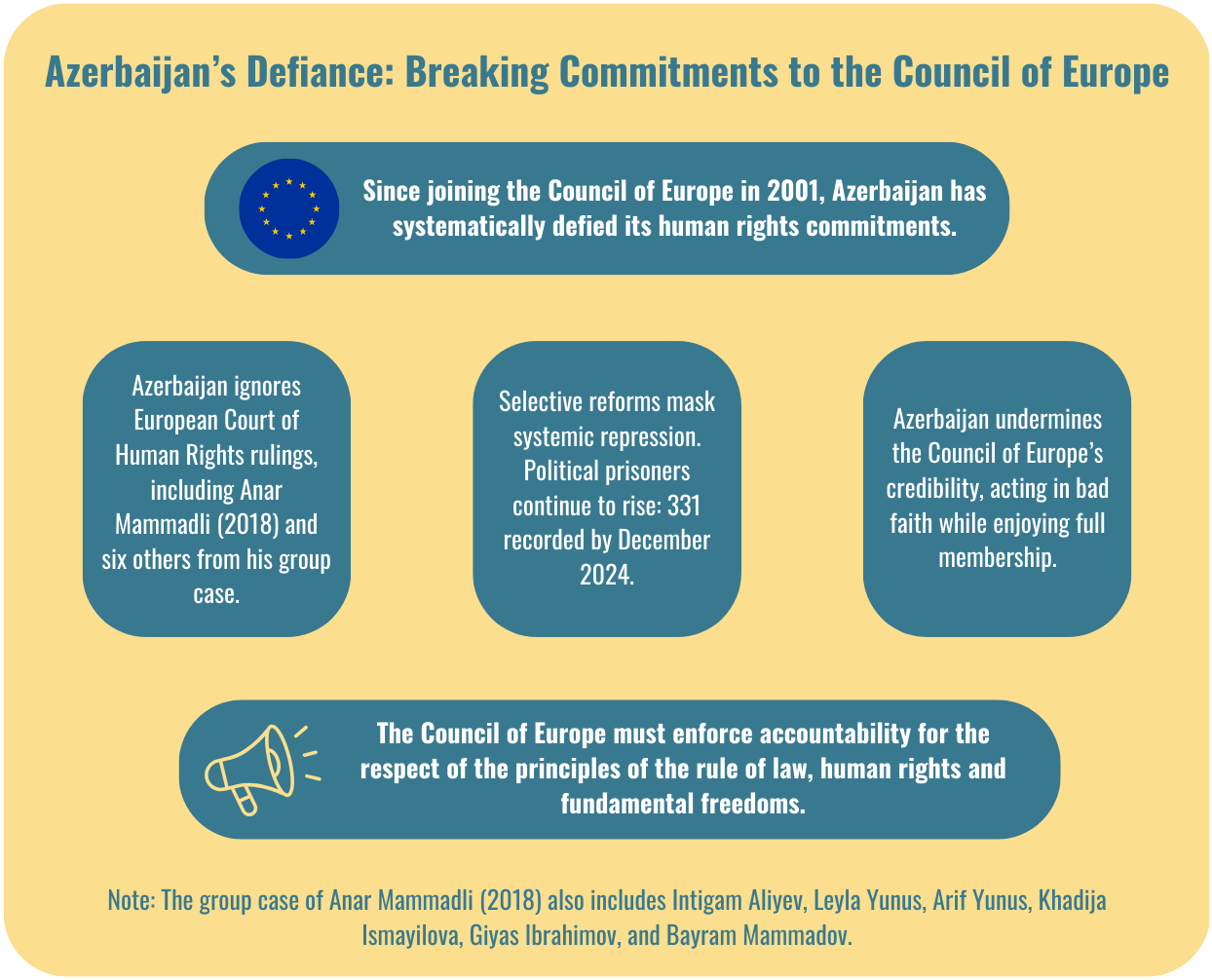
Our report “Azerbaijan’s Defiance: A Decade of Contempt for the Council of Europe” documents how this is not new: for years, Azerbaijan has cooperated selectively and on its own terms; and it has refused to engage on core issues such as political prisoners and systemic misuse of criminal law. The report also shows how the Council of Europe’s response has too often remained conciliatory, including through “business as usual” programming that did not change the trajectory on the ground.
Repression is at unprecedented levels; and the Council of Europe has not matched it with action
The human rights crisis has deepened, with a sharp increase in politically motivated detentions. Azerbaijani civil society reported 331 political prisoners in December 2024, a 256 percent increase compared to February 2023, which increased further to over 400 political prisoners at this time. New waves of arrests targeting journalists, civil society, civic activists, trade unionists, and academics, all aim at silencing not just dissent but any non-aligned opinion. The lists of recent raids, arbitrary detentions, travel bans, and transnational pressure on critics is never ending.
The European Court of Human Rights repeatedly stated the problem and alerted the Council of Europe’s political bodies. The Convention system depends on execution of judgments: Full execution requires both individual measures and credible general measures that prevent repetition, including reforms that ensure judicial independence and end misuse of criminal law. The Committee of Ministers’ long supervision of the Mammadli group of cases, with repeated decisions and interim resolutions that have not produced the needed outcomes should trigger further action by the Secretary General.
When a member state can ignore core Convention obligations over many years, the damage goes beyond one country. It signals that judgments can be treated as optional. That undermines legal certainty, weakens protection for victims, and invites further abuse by other bad-faith actors. In this sense, the current situation in Azerbaijan is a challenge to the credibility of the Council of Europe and the Secretay General’s inaction represents a risk for the institution itself.
What PACE should do at the Winter Session 2026
Given the lack of leadership at the Council of Europe to address Azerbaijan’s human rights crisis, the responsibility to act falls on the Parliamentary Assembly. The Assembly can be crucial in creaing a coordinated, institutional response that matches a systemic crisis.
Therefore, PACE should:
- Trigger the Joint Complementary Procedure so PACE and the Committee of Ministers act together. This should include clear benchmarks and time-sensitive expectations on cooperation, releases, and structural reforms;
- Strengthen sustained scrutiny through dedicated rapporteurship with a mandate for frequent public reporting and clear follow-up. The fact that Azerbaijan as Council of Europe member states decides not to participate to PACE anymore, thereby hindering the Assembly’s ability to monitor the situation in Azerbaijan, should be met with the creation of a specific rapporteurship by the Assembly. Not acting on this would effectively allow a Council of Europe member to silence the Assembly;
- Use public political pressure consistently, including coordinated statements and political engagement that name the problem and demand outcomes, starting with the release of people detained on politically motivated grounds and an end to judicial harassment, including Anar Mammadli whom the Assembly awarded with the Vaclav Havel Prize.
The Council of Europe was created to uphold individual freedoms, political liberties, and the rule of law. Azerbaijan’s decade of contempt, and the Organisation’s lack of reaction, has put that promise at risk. We believe the Parliamentary Assembly can help bring coherance and principle in addressing the human rights crisis in Azerbaijan through the launch of the Joint Complementary Procedure.
 EN
EN  AZ
AZ